
Essay Code and Repo Agents
Automated Pull Request Review Agent for Python Monorepos
Staged retrieval and memory let agents catch breaking changes across service boundaries.
An automated pull request review agent for Python monorepos must read a diff and reason about architecture. Catching cross-service breaking changes takes a staged pipeline that retrieves the right context, traces downstream contracts, and remembers service boundaries between reviews. The model is only one part of that design.
Why file-level review fails in a Python monorepo
A service boundary rarely lines up with the boundary of a pull request. A modified validation helper can affect a web application, a background worker, an SDK, and an internal CLI tool, even when none of those consumers appears in the patch. A change to a function default or to field optionality can look harmless in the changed code while breaking a contract elsewhere. The diff shows what changed, but not everything that depends on it.
Human reviewers bridge that gap by reconstructing ownership, tracing call sites, and deciding whether a breaking change is intentional. That work adds latency, while larger AI-generated PRs put further pressure on review capacity. Static analysis is still needed because SonarQube and Semgrep are good at catching known local patterns. But a local rule cannot replace contextual judgment about how a changed module interacts with its consumers.
What a cross-service review agent actually needs to reason about
The first requirement follows directly from the missing consumers. An agent needs repository-wide retrieval and a way to trace a changed symbol into the services that use it. It must establish which callers depend on a signature and which tests cover a changed field contract. Cubic frames the quality bar as identifying a concrete contract, caller, or boundary rather than warning that a change “may affect consumers”.
That evidence must become a finding an engineer can validate quickly, with a realistic failure path. The agent also needs to remember how services connect from one session to the next. Retrieval supplies the current code, while memory preserves the ownership knowledge and prior boundary failures that make that code easier to interpret.
The two-agent pipeline pattern and why it outperforms a single prompt
Atlassian’s Jira team used two agents in Bitbucket Agentic Pipelines to review a large shared frontend monorepo. A matcher paired changed files with team-specific guideline documents and wrote the handoff to tmp/pr-analysis.md. A reviewer then read only the matched documents before leaving inline comments. On one large pull request, the two steps finished in roughly seven minutes combined, compared with waits of up to half a day or a full day for a first human pass. Atlassian presents this as a single observed case, and the agent supplements human review.
The same design can work for Python, though the frontend case gives no evidence of how well it performs in Python. The matcher handles relevance, while the reviewer handles judgment within a curated context. That separation prevents unrelated team rules from flooding the review and lets each stage improve independently. It also makes well-written guideline files more important than elaborate prompts, because the reviewer’s authority comes from the material it receives.
How MCP connects the agent to the repository and CI surface
Once review is split into stages, those stages need a programmable route to repository operations. MCP supplies that integration layer by exposing actions as composable tool calls. A GitHub MCP server can expose list_pull_requests, get_file_contents, create_branch, and submit_review. Repository and CI tools then let the pipeline use its analysis to propose changes, run tests, and leave review comments.
The boundary matters because reasoning about an action is different from having permission to perform it. The agent chooses among available operations, while the exposed tools and their permissions define what it can do. Atlassian’s Bitbucket permissions provide a concrete example, with read:pullrequest:bitbucket allowing both access to PR details and comments. Tool wiring needs to be part of the review design from the start, before the prompts work.
Indexing the monorepo for cross-service context retrieval
Before reasoning begins, retrieval must bring the changed contract and its consumers into the same scoped context. Indexing strategy is a primary determinant of review quality because review depends on including the affected caller, regardless of model choice.
One option is a commercial context engine. Greptile also uses context from the whole codebase to check shared components and how modules work with each other.
A custom pipeline can instead start with a maintained cognition map in code_analysis.md. A thorough look through the repository records its workflows, key files and what they do, how to run evaluations, and script entry points. Later sessions use that map as their entry point for code localization. Buying a context engine and keeping a map suit teams of different sizes and budgets, but both need to be kept up to date.
Persistent memory and why session-based agents cannot maintain service boundary awareness
An up-to-date map describes the repository, but it does not by itself preserve everything learned during review. A session may discover a fragile service interaction, only to lose that understanding when its context is compacted or the session ends. Starting each PR from scratch forces the agent to reconstruct boundary knowledge.
Context hydration keeps that knowledge in use by loading the saved information that matters before the new review begins. The active context can include team preferences, semantically similar review summaries, and recent records of troublesome service interactions. Letta offers a model through core memory that stays in context, searchable recall memory, and archival memory backed by external vector or graph databases. These layers keep stable facts about ownership and the full review history in different places, so every prompt can use just the parts it needs.
Noise control and how to prevent irrelevant comments
Even sound retrieval can produce an unusable review if the agent comments on everything it sees. Broad prompts invite style preferences, subjective objections, and findings unrelated to the changed service. Developers then inherit another queue to work through before reaching a merge decision.
First, matcher-first routing applies the relevant team’s guidelines, as in the Atlassian pattern. Next, confidence thresholds, suppression of comments on untouched lines, and deduplication against review history narrow the output. Feedback then tunes what remains to the repository’s actual review culture. Cubic learns from user feedback and supports configured coding standards, while Greptile exposes a strictness setting and CodeRabbit carries “Learnings” between reviews. These controls address different sources of noise, so a stricter prompt alone is not a substitute for routing and feedback.
Human reviewers bridge that gap by reconstructing ownership, tracing call sites, and deciding whether a breaking change is intentional.
Self-hosted versus hosted deployment for Python teams
Deployment starts with where the code is allowed to go. The open-source anc95/ChatGPT-CodeReview sends diffs to an external LLM API, using OpenAI by default with Azure or GitHub Models as alternatives. That is straightforward to deploy without managing infrastructure, but it leaves a real data residency question. Self-hosted alternatives can remove that exposure at the cost of deployment and ongoing operations.
PR-Agent and Tabby can be self-hosted, while Kodus supports both bring-your-own-key and self-hosted deployment. The supplied evaluation material shows promise for Kodus, but leaves it unproven in production at large-monorepo scale. Teams with residency requirements should plan for deployment to take weeks and for the work of running it to continue. Teams without that constraint should first evaluate hosted tools on signal-to-noise and integration depth, then revisit residency if it becomes a requirement.
A tool-by-tool map of the current Python monorepo review landscape
The useful distinction is what each tool can establish. Semgrep Community Edition and SonarQube use rule-based checks to find known patterns, but cannot judge the architecture across services. CodeQL adds a GitHub-native analysis option with no AI component and is production-viable on public repositories. These tools form a complementary gate.
Among AI reviewers, CodeRabbit emphasizes style consistency and platform breadth across GitHub, GitLab, Bitbucket, and Azure DevOps, but can miss cross-module interactions. Its retained learnings help reduce repeated noise. Qodo has multi-repository awareness and detects test coverage gaps during review, with test generation available through Qodo Gen and Qodo Cover. Tabby offers self-hosted review with local model support, although reliability in reaching local models is a caveat.
For cross-service reasoning, Greptile’s whole-codebase context and configurable strictness address both retrieval and comment precision. Cubic offers cross-file and package-aware review for GitHub, but not GitLab or Bitbucket, and reviews up to 200 high-priority eligible files when a PR exceeds that threshold. Gitar extends review into remediation by committing validated fixes and iterating on CI failures, while posting lower-confidence findings as suggestions. These capabilities answer different parts of the architecture, so context breadth, platform fit, coverage, and execution depth remain separate selection criteria.
Building the pipeline as a stage-by-stage design
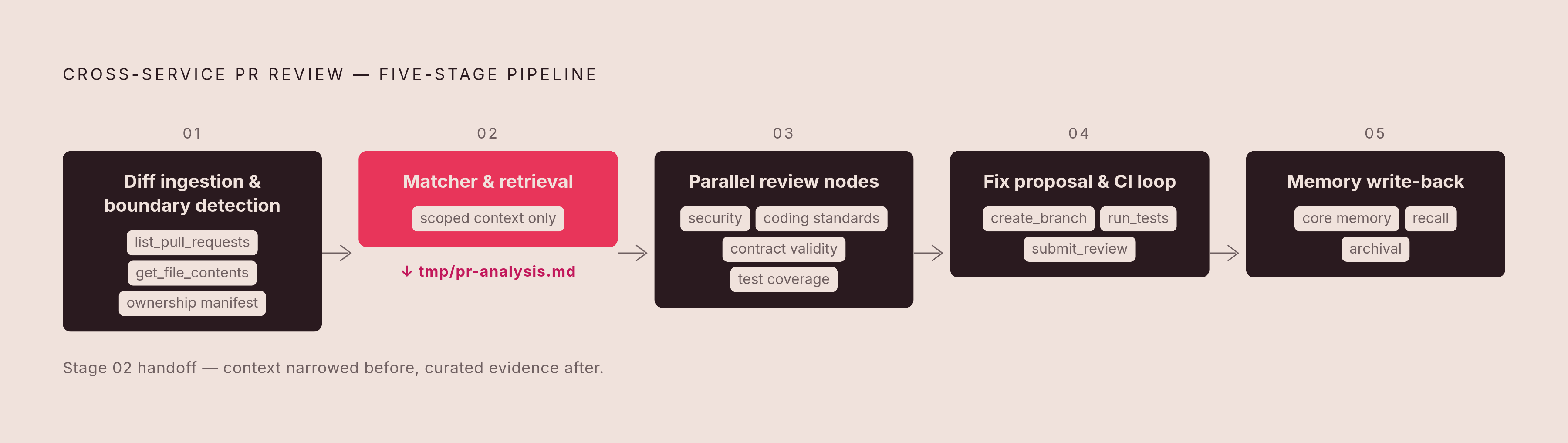
The pipeline brings those capabilities together in stages that each have a limited scope and structured outputs. Beneath them, the runtime handles PR-open and synchronization triggers, persistent state, and MCP connections. Each stage gets a limited task rather than responsibility for understanding and fixing the entire repository. That keeps the handoffs explicit as the monorepo grows.
Stage 1 ingests the diff and detects service boundaries. The GitHub MCP surface, including list_pull_requests and get_file_contents, supplies repository inputs. The directory structure and a pre-built ownership manifest show which services the changed paths and hunks belong to. Exported functions, class signatures, and shared constants that cross boundaries become inputs to downstream reasoning.
Stage 2 is the matcher and retrieval step. It gathers the relevant guidelines and cognition-map entries for affected consumers, then queries the vector index for related code that imports or calls changed symbols. The matched material goes into tmp/pr-analysis.md, following the Atlassian handoff pattern. The reviewer reads that scoped artifact rather than receiving the full repository indiscriminately.
Stage 3 uses separate LangGraph nodes to run review passes for security, coding standards, cross-service contract validity, and test coverage. Each node returns structured Pydantic findings from the same bounded evidence. Findings on security and contract validity must meet higher confidence thresholds before they become comments. Style findings have lower priority and are suppressed on files outside the PR author’s team ownership.
Stage 4 connects findings to fixes and CI. For high-confidence findings, the agent proposes a change, uses create_branch, pushes the fix, and invokes CI tools such as run_tests and get_coverage_report. Gitar supplies the model for iterating on CI failures until the pipeline is green. Lower-confidence findings become inline comments through submit_review, leaving the decision with the human reviewer.
Stage 5 writes the result of the review back to persistent memory. The record includes the flagged service boundary, its risk, and whether the author accepted or dismissed the comment. Following Letta’s hierarchy, ownership facts belong in core memory, per-PR findings in recall, and historical boundary failures in searchable archival memory. This final handoff gives the next review access to what the current one learned.
Operational concerns and keeping the agent calibrated
The repository and the way people review it keep changing after deployment. Guideline files need a review cadence, and cognition maps and indexes need maintenance as services evolve. Latency also depends on retrieval time, indexing freshness, and model inference. A fast conclusion drawn from stale context is still the wrong conclusion.
Coverage needs equal attention. Tools with file limits can omit critical shared packages from large changes, so teams should prioritize shared boundaries and split large refactors into reviewable units. When a fix is accepted, it should give more weight to similar findings at the same boundary, while repeated dismissals should help decide which findings to suppress. SonarQube, Semgrep, and open-source linters remain complementary checks because AI review does not replace deterministic gates.
Over time, the infrastructure needs to let the agent keep that calibration and act without someone starting it by hand each time. With a purpose-built agent operating system, the runtime itself handles memory, scheduling, context hydration, and failure recovery. That is the distinction between a webhook-driven review script that loses its context and a persistent, proactive codebase-aware agent. Architectural review becomes sustainable when the runtime preserves the understanding that file-level tools never had.